When a heavy-duty engine needs a rebuild, the job doesn’t start with parts. It starts with a decision. Do you go back with OEM, or do you look at aftermarket rebuild kits?
OEM parts have always been the default. They match what came in the engine from the factory, and for a long time, that was enough to justify the cost. But the aftermarket has changed.
Today, aftermarket rebuild kits are built to meet OEM specifications and, in many cases, improve on them. For fleets, owner-operators, and technicians focused on uptime and cost control, the aftermarket is no longer a backup option. It is often the more practical choice.
Understanding the Difference Between OEM and Aftermarket Rebuild Kits
OEM rebuild kits are produced by the original engine manufacturer. These kits are designed to replicate the components used during the initial assembly of the engine. For operators who want to maintain the exact factory configuration, OEM kits provide that consistency.
Aftermarket rebuild kits are developed by manufacturers that specialize in replacement engine components. These companies design parts to match OEM tolerances while also applying updated engineering based on field experience.
The difference between OEM and aftermarket is not simply about who makes the part. It comes down to how the part is developed and what it is designed to achieve.
OEM components are built to match original specifications. Aftermarket components are built to meet those same specifications while addressing wear patterns, material limitations, and performance considerations observed over time.
As a result, modern aftermarket diesel engine rebuild kits often reflect years of real-world application data. This allows for improvements in durability, efficiency, and overall engine life.
What’s Included in a Complete Engine Rebuild Kit?
A complete diesel engine rebuild kit is designed to provide the essential components required to restore a worn engine to proper operating condition.
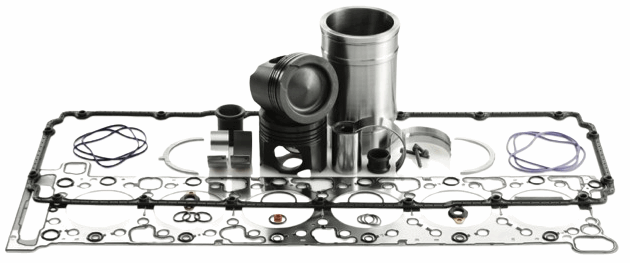
While specific contents vary depending on the engine platform, most heavy-duty engine rebuild kits include the following:
- Pistons
- Cylinder liners
- Bearings
- Gasket sets
- And more…
These components represent the primary wear items inside an engine. Replacing them during a rebuild helps restore compression, improve efficiency, and extend service life.
Rebuild kits are typically categorized into two types.
In-frame rebuild kits are used when the engine remains installed in the equipment. These kits include the components needed to service internal wear parts that can be accessed without removing the engine.
Out-of-frame rebuild kits are used when the engine is removed for a complete teardown. In addition to major internal components, these kits include expanded gasket and seal coverage required for full disassembly and reassembly.
Packaging these parts together reduces sourcing time and helps ensure that all required components are available during the rebuild process.
Key Advantages of Aftermarket Rebuild Kits
Aftermarket manufacturers design rebuild kit components to meet precise OEM tolerances. This ensures compatibility and proper engine function after installation.
In many cases, these manufacturers go a step further by refining component design. Improvements may include stronger materials, updated coatings, or adjustments that address known wear areas.
These enhancements are based on long-term performance data gathered from engines operating in real-world conditions. The result is a rebuild kit that not only restores the engine but may also improve durability over the original configuration.
1. Cost Savings Without Cutting Corners
One of the most recognized advantages of aftermarket rebuild kits is cost efficiency.
OEM parts are often distributed through dealership networks, which can increase pricing due to markup and supply chain structure. Aftermarket suppliers operate through more direct channels, allowing them to offer competitive pricing without reducing quality.
It is also important to understand that many OEM components are manufactured by third-party suppliers. These same suppliers may also produce components for the aftermarket.
This means that in some cases, similar or identical parts are available at a lower cost through aftermarket sources.
For fleets managing multiple units or planning long-term maintenance cycles, these savings can have a measurable impact on overall operating costs.
2. Faster Availability and Reduced Downtime
Availability is a critical factor during any engine repair.
OEM rebuild kits may require ordering through a dealer network, which can result in longer lead times. This is especially true for older engines or less common configurations.
Aftermarket rebuild kits are typically stocked and ready for shipment. This reduces waiting time and helps minimize downtime.
For industries where equipment utilization directly impacts revenue, reducing downtime is a key priority. Faster access to parts allows repairs to be completed more efficiently and equipment to return to service sooner.
3. Strong Warranty Coverage
There is a common assumption that aftermarket parts come with limited protection. In practice, many aftermarket rebuild kits include warranty coverage that is comparable to or longer than OEM offerings.
Warranty terms vary by manufacturer, but they often reflect confidence in product quality and performance.
This level of coverage provides additional assurance for operators investing in a full engine rebuild.
Where OEM Rebuild Kits Still Make Sense?
While aftermarket rebuild kits provide clear advantages, OEM kits still have a role in certain applications.
For example, engines that are still under factory warranty may require OEM parts to maintain coverage. In these cases, using OEM rebuild kits helps ensure compliance with warranty terms.
OEM kits may also be preferred in situations where strict adherence to factory specifications is required. Some operators choose OEM components to maintain consistency across their equipment or to meet internal maintenance standards.
These scenarios are typically specific and do not apply to all rebuild situations. For many applications, aftermarket rebuild kits provide a more flexible and cost-effective option.
Common Misconceptions About Aftermarket Rebuild Kits
Despite advancements in manufacturing and engineering, several misconceptions about aftermarket rebuild kits still exist.
One common belief is that aftermarket parts are lower in quality. This perception is outdated. Modern aftermarket manufacturers follow strict quality control processes and use advanced materials to ensure durability.
Another misconception is that aftermarket parts may not fit properly. Fitment is determined by engine specifications and serial numbers. Reputable suppliers verify compatibility before supplying parts.
There is also an assumption that OEM rebuild kits always include new components. In some cases, OEM kits may include remanufactured parts depending on the manufacturer.
A final misconception is that aftermarket suppliers do not support newer engines. While there may be a short delay as new platforms are introduced, aftermarket manufacturers consistently develop components for modern engines.
Understanding these points helps provide a clearer picture of what aftermarket rebuild kits offer today.
Why IPD Rebuild Kits Are Trusted by Engine Rebuilders?
IPD rebuild kits are designed to support reliable engine restoration across a wide range of heavy-duty applications. These kits are engineered for both diesel and spark-ignited gas engines used in transportation, construction, mining, marine, oil and gas, and power generation industries.
IPD offers both in-frame and out-of-frame rebuild kits, allowing the rebuild process to match the scope of the repair. Each kit is developed to include the core components required for a rebuild. Packaging is designed to organize components clearly, helping technicians manage the rebuild process efficiently.
IPD rebuild kits support major engine platforms, including Caterpillar, Cummins, Waukesha, and Detroit Diesel.
Key features of IPD rebuild kits include:
- Components designed for durability and consistent performance
- Complete rebuild solutions that simplify sourcing
- Coverage for a wide range of engine applications
- Packaging that supports efficient installation and reduces errors
By focusing on fit, function, and real-world performance, IPD provides rebuild kits that support long-term engine reliability.
Choosing the Right Rebuild Kit for Your Engine
Selecting the correct rebuild kit requires careful consideration of several factors.
Application is one of the most important considerations. Engines used in on-highway trucks, construction equipment, marine environments, or industrial settings may have different performance requirements.
The type of rebuild also plays a role. In-frame rebuilds address internal components without removing the engine, while out-of-frame rebuilds involve full disassembly.
Engine condition should also be evaluated. A high-hour engine may benefit from a complete rebuild, while a less-worn engine may only require partial service.
Budget and long-term maintenance goals should also be considered. Some operators prioritize immediate cost savings, while others focus on extending engine life as much as possible.
Working with experienced parts specialists and verifying engine serial numbers helps ensure proper fitment and reduces the risk of delays during installation.
Making the Right Choice Between Aftermarket and OEM Rebuild Kits
Choosing between OEM and aftermarket rebuild kits is no longer a question of quality versus compromise.
Aftermarket rebuild kits provide a combination of performance, availability, and cost efficiency that aligns with the needs of modern operations.
OEM rebuild kits still have a place in specific situations, particularly when warranty requirements or strict specifications are involved.
For many operators, however, aftermarket rebuild kits offer a practical solution that supports reliable engine performance while helping control costs and reduce downtime.